Focus on Customized High Speed Brush Machine since 1988.
Language
Brushes are indispensable across sectors, ranging from household cleaning and cosmetic applications to industrial manufacturing and electronics. Each of these industries needs specific brush characteristics like filament stiffness, base shape, bristle arrangement, and material tolerance.
For instance, nylon strip brushes are used in conveyor systems, while twisted-in-wire brushes serve plumbing and medical applications. Meeting these diverse requirements calls for machinery capable of precise, repeatable production across various designs.
Modern brush making machine manufacturers have the capacity to handle this complexity. They use programmable multi-axis systems, automated tufting heads, and integrated trimming units for efficient production. Let’s see how these manufacturing machines produce different brush types with precision.
Types of Brushes Produced by Machines
Modern brush making machine manufacturers use quality machines that come with many applications. These machines can produce everything from mass-market household products to precision-grade industrial and cosmetic tools. Each brush type requires a tailored production process, involving specific filament types, tufting methods, and base materials.
Household Brushes
Household brush production requires high-volume output, cost-efficiency, and robust construction. Machines come with support for staple-set tufting and CNC-controlled drilling, optimized for plastic or wooden brush blocks. Broom and toilet brush machines often feature 3-axis brush machines or 5-axis brush machines that enable tufting at varied angles.
Dish brushes and cleaning pads may require double-end tufting or dual-material filament feeding, allowing the brush head to serve multipurpose cleaning tasks. Machines often integrate automatic trimming stations and flagging units that soften bristle tips for a consumer-friendly finish.
Industrial Brushes
For industrial brush manufacturing, dimensional accuracy, abrasion resistance, and customization are essential. Steel wire, bristle, horsehair, abrasive nylon, silicon carbide, or aluminum oxide, which are typically fastened to metal cores. Common brush types include linear strip brushes, disc brushes, roller brushes, and twisted-in-wire brushes.
Machines typically feature rotary axis control, servo-driven feeding, and multi-drill heads capable of dense filament packing. Strip brush machines use horizontal bed feeding for continuous channel filling, while roller brush machines require live-axis rotation. These machines also include plasma cleaning units, curing ovens, and epoxy injection modules.
Cosmetic Brushes
Cosmetic brush production is all about aesthetic precision, filament uniformity, and soft-touch performance. Makeup machine brushes use ultra-fine synthetic fibers like taklon, polybutylene terephthalate [PBT], or natural hair like goat, sable. Similarly, CNC-controlled tufting machines with clamps allow for shaping various brush styles that are used in skincare routines.
Hairbrush production involves inserting nylon, boar bristles, or hybrid filaments into rubber cushion pads or injection-molded plastic handles. Machines use anchor-free pneumatic insertion or semi-automatic staple-set heads. Flagging units help texture the bristle tips for scalp-friendly detangling, while profile cutting tools ensure symmetrical brush face design.
Specialty Brushes
Specialty brushes require custom engineering to match niche functionality and compliance standards. Paintbrush machines typically support flat and angular filament arrangements, with epoxy-setting stations for filament bonding and trimming tables for shaping heads. Filaments may include China bristle, synthetic blend, or flagged PET to ensure proper paint pickup and release.
For shoe brushes, dense bristle placement, hardwood bases, and leather-polishing filaments such as horsehair or pig bristle are common. Whereas, medical-grade brushes require sterile-grade filament handling, FDA-approved materials. These machines are usually modular with quick-change tooling, anti-static shielding, and ISO-certified material tracks.
How Machines Vary for Different Brush Types
Brush making machine manufacturers build machines that are different in structure, speed, and material handling. Below are the major machine categories and how each is uniquely designed to meet specific production needs.
Single vs. Multi-Head Tufting Machines
·Single-head machines are ideal for small-scale or custom brush production.
·Multi-head machines (2 to 5 heads) allow multiple tufts to be inserted simultaneously, increasing output speed.
·Multi-head systems are used for high-volume production of items like brooms and toilet brushes.
·Greater complexity in setup and programming, but higher efficiency per cycle.
Rotary Brush Machines
·Designed for producing cylindrical, disc, and roller brushes.
·Use a rotating axis to evenly distribute tufts around a circular base.
·Suitable for industrial applications like conveyor cleaning, printing rollers, and polishing.
·Often support twisted-in-wire or anchor-set tufting methods.
Strip Brush Machines
·Built for linear and continuous tufting on aluminum, plastic, or steel channels.
·Ideal for making sealing brushes, dust covers, escalator brushes, and weatherstrips.
·Include horizontal feeding systems for long-length or custom-shaped strip brushes.
·Some models offer channel bending to create curved or spiral strips.
Hairbrush and Cosmetic Brush Assemblers
·Focused on precision filament placement and soft material handling.
·Support ultra-fine synthetic and natural fibers like Teflon, PBT, or goat hair.
·Include flagging units for softening bristle tips and CNC-guided trimming tools for uniform profiles.
·Used for producing premium makeup brushes, hair detanglers, and scalp massage brushes.
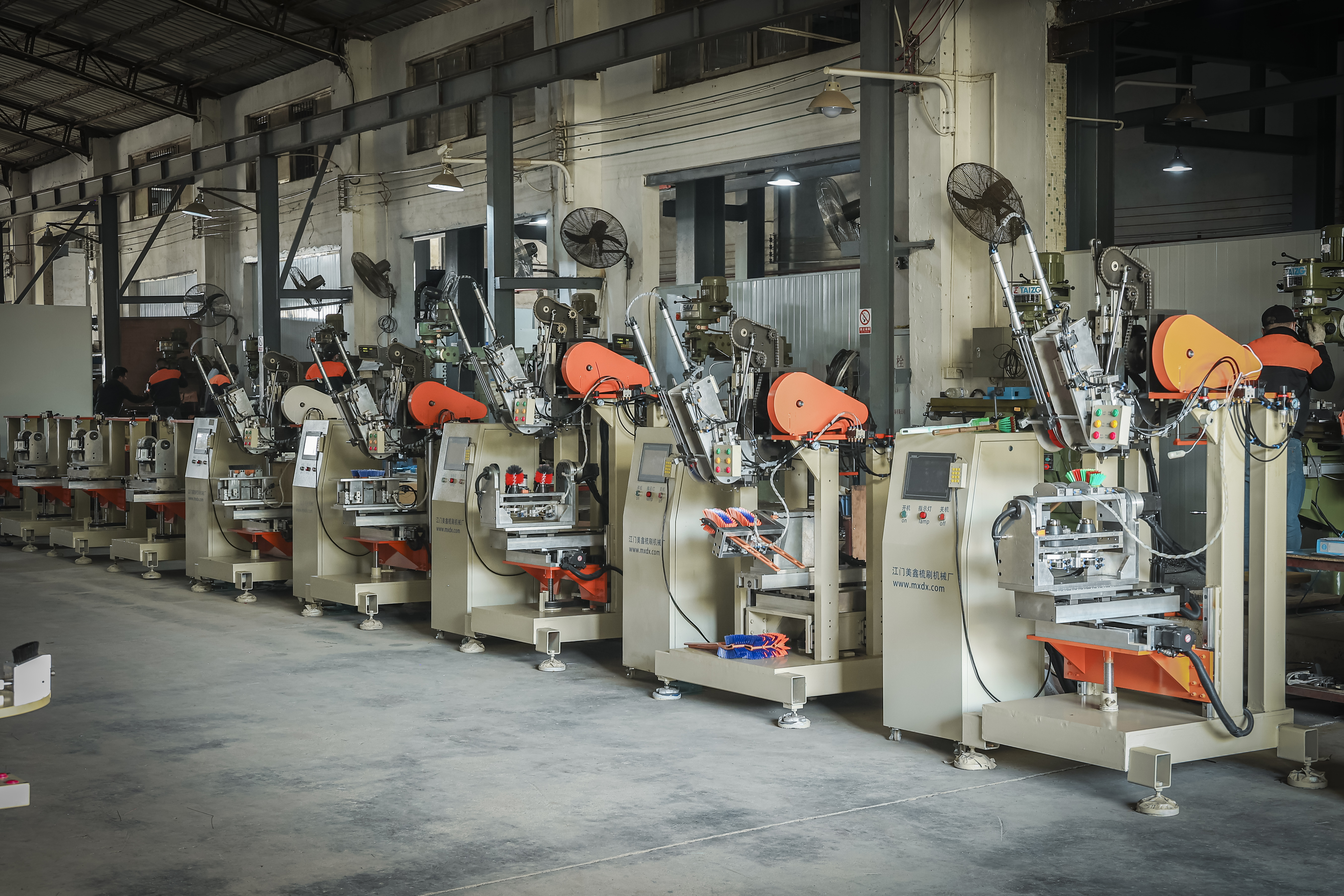
How Speed and Filament Handling Define Machine Performance
Brush making machines differ widely in performance based on their speed (tufting cycles per second), precision (placement accuracy), and ability to handle various filament types. High-output machines can achieve speeds of 5 to 8 holes per second, especially when equipped with 2–5 tufting heads.
These machines use servo motors and CNC controls to maintain cycle consistency and are ideal for producing thousands of brushes per shift with moderate tolerance levels (±0.2 mm).
Precision-focused machines, such as those for cosmetic or medical-grade brushes, operate slower, around 1.5 to 3 holes per second, but offer far tighter control, often achieving placement accuracy of ±0.05 mm. These systems support ultra-fine filaments like taklon, PBT, or natural hair.
Industrial machines, on the other hand, must manage abrasive filaments like silicon carbide, nylon, or steel wire, requiring reinforced feeding channels, tension-regulated clamps, and heavy-duty tufting arms to maintain alignment under load.
Conclusion
Today’s brush making machine manufacturers are building advanced, multi-axis systems designed for diverse brush types, ranging from simple household brushes to industrial-grade and cosmetic variants. With improvements in automation, precision, and material compatibility, the right machine can significantly improve output quality and reduce manufacturing downtime.
If you’re looking for a brush making machine for sale that delivers speed, durability, and customizability, explore our full range at mxburshmachineryvideo.com. Whether you need a 2,3,4-axis solution or a fully automated 5-axis production line, we offer machines built to match your specific brush manufacturing goals.
Meixin Comb Brush Machinery
A leader in this industry ,specializing in brush making machine line for more than 38 years

